The United Nations General Assembly has approved a resolution calling for global adoption of a new world map that enlarges Africa.
The new world map reduces the visual dominance of North America and Europe, a symbolic shift that supporters say corrects long‑standing cartographic bias.
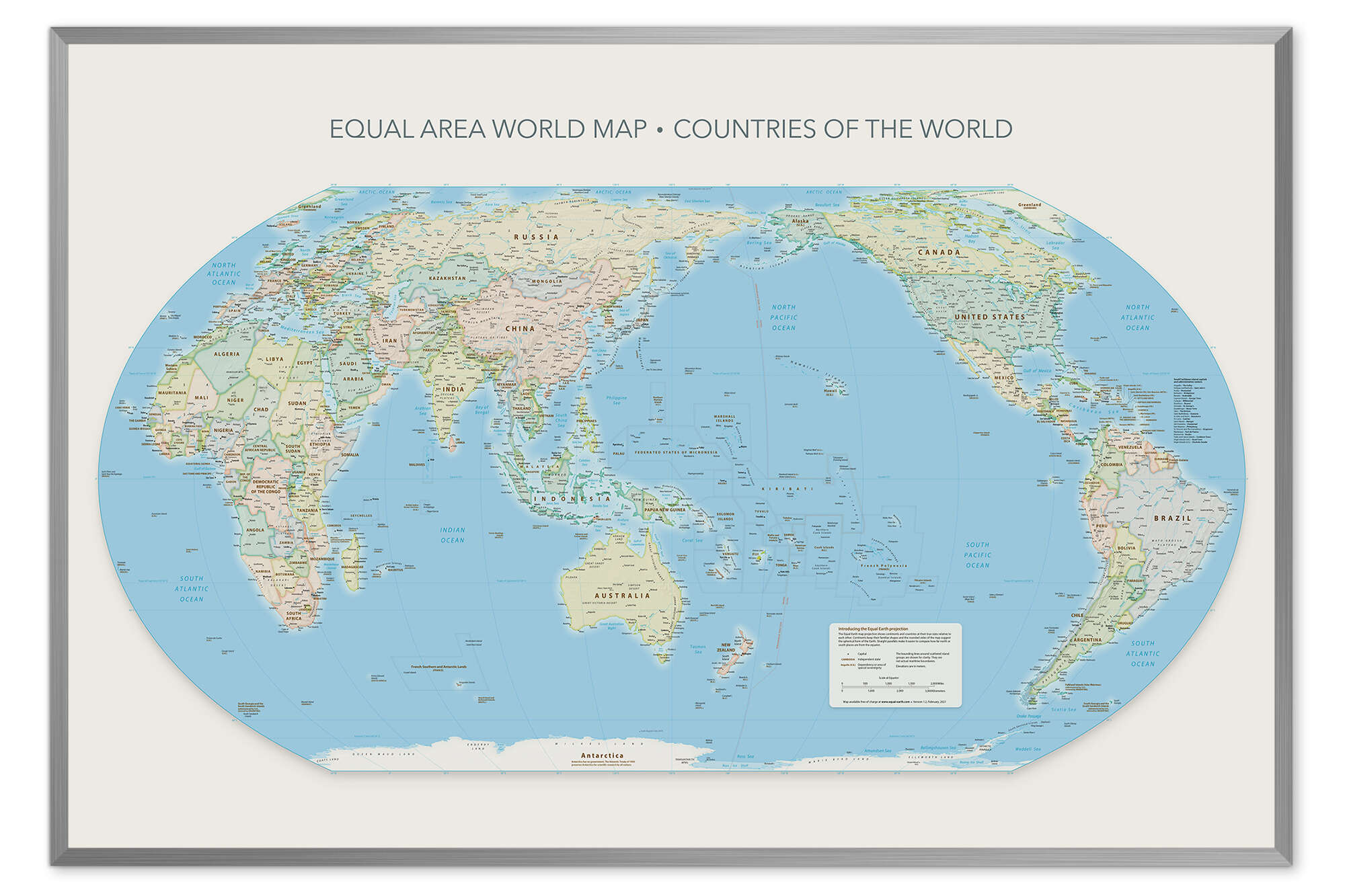
The measure, led by Togo and backed by 164 countries, endorses the Equal Earth projection, a map created in 2018 to more accurately represent the relative size of continents. The United States voted against the resolution, while six nations abstained.
In its adoption, the UN said the Equal Earth projection offers “a more accurate representation” of global landmasses and encourages governments, schools and international institutions to replace the centuries‑old Mercator projection, which has long been criticized for exaggerating the scale of northern regions.
Togo’s foreign minister, Robert Dussey, told delegates that maps “guide education, nourish the imagination, and influence collective perceptions,” adding that distorted depictions risk reinforcing “inaccurate representations passed down through generations.”
The Mercator projection, developed in 1569 by Flemish cartographer Gerardus Mercator, was designed for navigation.
Its mathematical structure preserves angles and shapes but dramatically inflates areas farther from the equator. As a result, Greenland appears nearly the size of Africa, and Europe and North America seem far larger than they are.
The Equal Earth projection, created by a team of cartographers in 2018, aims to correct those distortions. It enlarges Africa, Latin America, South Asia and Oceania, while reducing the apparent size of northern powers.
“Equal Earth preserves the relative surface areas of continents and, as much as possible, shows their shapes as they appear on a globe,” cartographer Bojan Šavrič told AFP last year.
France, which co‑sponsored the resolution, announced it will phase out the Mercator map in official use.
Foreign Minister Jean‑Noël Barrot said the traditional projection gives the United States, Russia and China “a disproportionate visual prominence,” while shrinking Africa and Southeast Asia. “Changing maps obviously doesn’t change the world,” he said. “But correcting a distorted representation is already an act of truth.”
The United States sharply opposed the measure. US representative Yaryna Ferencevych said the debate reflected misplaced priorities at the UN.
“Instead of focusing on genuine problems, this body is debating map projects from the 16th century and their role in promoting reparations and cognitive justice,” she said.
The vote comes amid broader diplomatic efforts by African nations to challenge historical narratives and assert greater influence in global institutions.