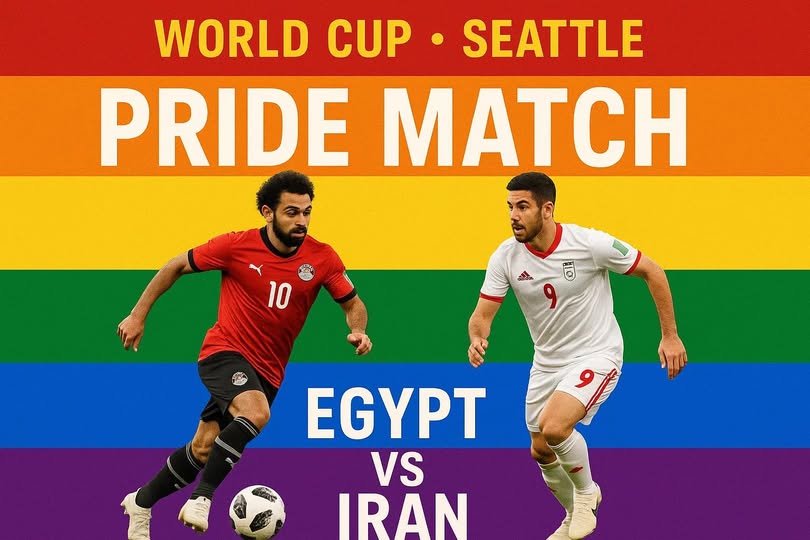
Egypt and Iran, set to face each other in the third round of the World Cup group stage, have rejected the branding their fixture as the “Pride Match.”
The game, scheduled for Friday, June 26, 2026, in Seattle, coincides with the start of Seattle Pride weekend.
Local organizers intended to use the occasion to showcase the distinct character of our region and embody the unifying spirit of the World Cup reminding all that inclusion is Seattle’s greatest strength.”
However, the Egyptian Football Association in a statement, believes the plan “contradicts the cultural, religious, and social values of the region, particularly in Arab and Muslim societies.”
Similarly, the Iranian Football Federation President Mehdi Taj in an interview with state television, called the plan “unreasonable conduct that supports a specific group.”
He added that both Tehran and Cairo have relayed their objections to FIFA.
Both Iran and Egypt have strict stances against LGBTQ+ rights.
In Iran, same-sex relations are criminalized under Sharia law and can carry the death penalty. In Egypt, authorities prosecute LGBTQ+ individuals under provisions related to “debauchery” and “public morals” in the penal code.
Read the full statement from the Egyptian FA below:
The Egyptian Football Association (EFA) sent an official letter to FIFA, categorically rejecting any activities promoting homosexuality during the Egypt-Iran match scheduled to take place in Seattle, USA, on June 26, 2026, as part of the third round of the group stage of the 2026 World Cup.
In the letter addressed to FIFA Secretary General Mattias Grafström, the EFA confirmed that it had received information indicating that the local organizing committee had decided to hold activities related to supporting homosexuality during the match. The EFA stated that it completely rejects such activities, which directly contradict the cultural, religious, and social values of the region, particularly in Arab and Muslim societies.
The EFA explained in the letter that while FIFA is committed to ensuring a respectful and welcoming environment for all fans, and in order to maintain a spirit of unity and peace, it is essential to avoid including activities that could provoke cultural and religious sensitivities among fans from both Egypt and Iran, especially since such activities are culturally and religiously incompatible with the traditions of both countries.
The Egyptian Football Association (EFA) based its letter on FIFA’s principles as stipulated in its Statutes, specifically Article 4, which emphasizes neutrality in political and social matters. This article mandates maintaining neutrality in political and social issues during FIFA competitions and ensuring that football is not used as a platform to promote sensitive or controversial causes.
The EFA also cited FIFA’s Disciplinary Code and Event Regulations, which explicitly state that FIFA competitions must remain free from any manifestations that could incite tension, misunderstanding, or conflict between fans from different backgrounds.
Furthermore, the EFA invoked FIFA’s long-standing principle of respecting cultures and encouraging all parties to organize events in a manner that respects the beliefs and identities of participating communities. Therefore, to ensure the match is held in an atmosphere of respect and focuses solely on the sporting aspect, the EFA categorically rejects these calls and demands that FIFA prevent any events or displays related to LGBTQ+ rights from taking place inside the stadium on match day.